The Complete History of Cannabis – A Global Timeline: Part 7
Part of the Cannabis Education Series. This part of our series traces the most consequential six years in South Africa's cannabis history. The road from the 2018 Constitutional Court judgment to the Cannabis for Private Purposes Act of 2024. It's a story that's often misremembered as the day cannabis "became legal", and the truth, as always, is more interesting than the headline.
Read more:
- The Complete History of Cannabis – A Global Timeline: Part 1
- The Complete History of Cannabis – A Global Timeline: Part 2
- The Complete History of Cannabis – A Global Timeline: Part 3
- The Complete History of Cannabis – A Global Timeline: Part 4
- The Complete History of Cannabis – A Global Timeline: Part 5
- The Complete History of Cannabis – A Global Timeline: Part 6
2018–2024: From Prince to Proclamation: How South Africa Rewrote Its Cannabis Law
When the Constitutional Court handed down its cannabis judgment on 18 September 2018, much of the country read it as a single, simple headline: dagga was now legal.
It wasn't, at least not in the way most people assumed. And the gap between what the Court actually said and what people believed it said would shape the next six years of South African cannabis policy.
The judgment did something narrower, and more interesting, than legalisation. It found that criminalising an adult for using, possessing or growing cannabis in private, for their own use, was an unjustifiable invasion of the right to privacy.¹ But the Court did not write a cannabis law. It couldn't, and it said so. Instead, it handed Parliament a deadline (24 months to fix the offending provisions in existing legislation) and left a temporary legal patch in place until that happened.
What followed was not a clean break with prohibition. It was a slow, contested handover from the courts to Parliament that finally produced the Cannabis for Private Purposes Act 7 of 2024.² Even that, as we'll see, wasn't the end of the story.
2018: A ruling, not a green light
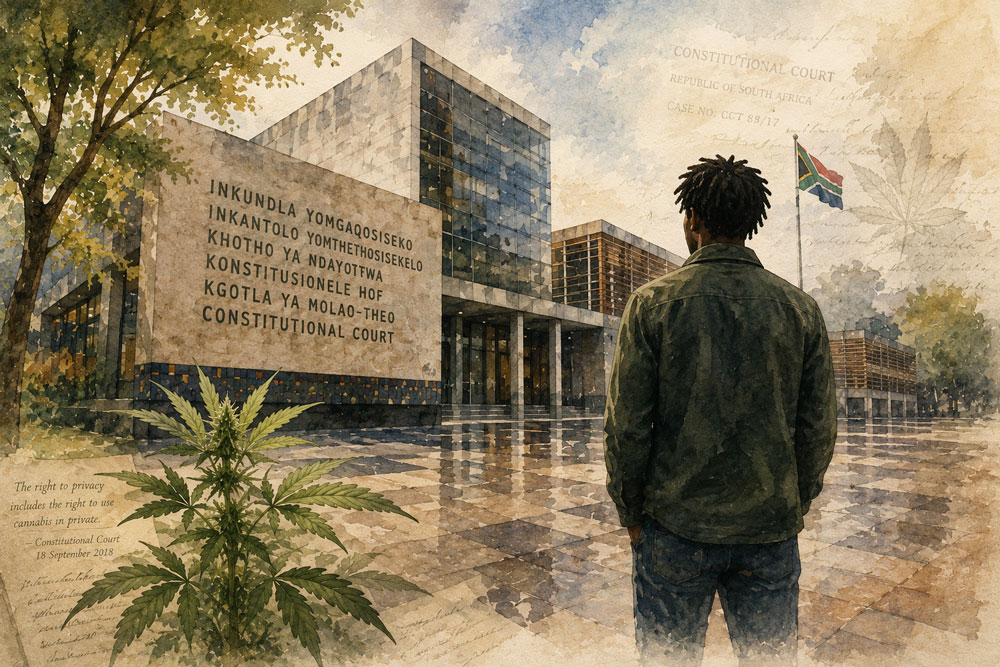
The case is usually remembered as the Prince judgment – Minister of Justice and Constitutional Development and Others v Prince and Others. In it, the Court confirmed that an adult may use, possess and grow cannabis in private for personal consumption, and it pointedly noted that "private" doesn't stop at your front door.¹
That last point mattered. But so did everything the Court deliberately left untouched.
The judgment said nothing about selling. It created no shops, no licences, no legal supply chain. It didn't put a number on how much an adult could hold or how many plants they could grow. It didn't touch public use. All of that was left for Parliament to work out, which is precisely why the ruling protected a slice of private behaviour without opening a cannabis economy.
For the moment, South Africa had stopped treating certain private conduct as a crime. It had not built anything in its place.
2019–2020: The regulators start drawing lines
While Parliament worked on the legislation, a quieter shift was happening on the regulatory side, and it introduced a distinction that still trips people up today.
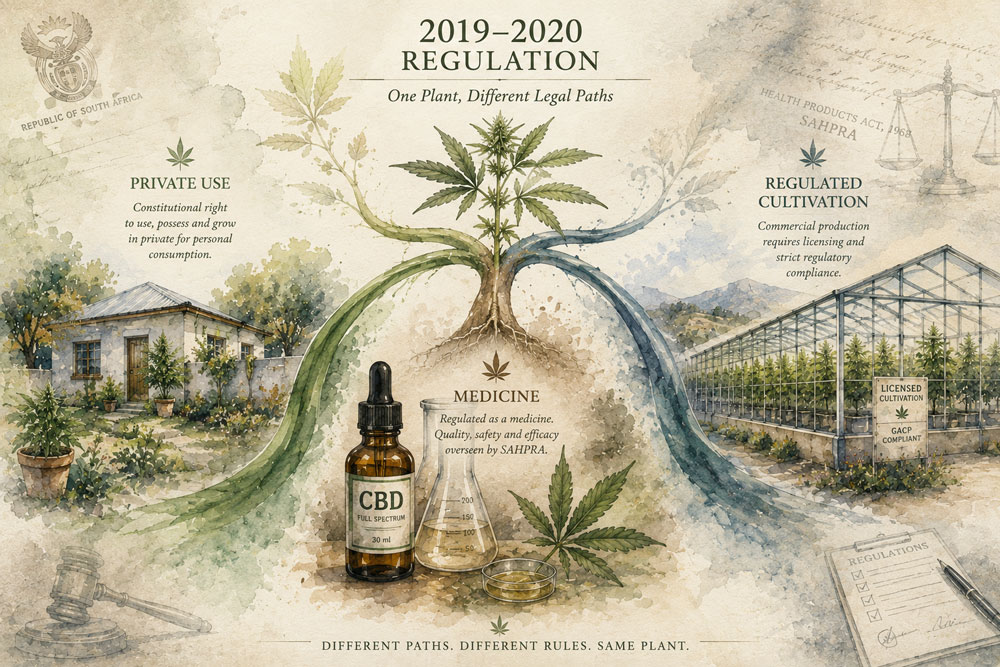
In 2019, South Africa carved out a temporary exemption for certain low-dose cannabidiol (CBD) preparations, freeing them from the strictest scheduling rules under defined conditions. The health products regulator, SAHPRA, followed with further scheduling changes affecting both CBD and THC.³
The effect was to separate cannabis into categories that the law had previously lumped together. Cannabis grown by an adult for a private joint, a CBD tincture on a pharmacy shelf, a THC-based medicine, and a licensed medical crop were no longer the same legal object.
By 2020, SAHPRA had removed the cannabis plant from Schedule 7 entirely, while keeping THC scheduled, subject to exemptions, one of which was written to accommodate exactly the private cultivation and use the Constitutional Court had protected.³ Cannabis grown as medicine stayed firmly inside the medicines system.
The takeaway is easy to miss and worth stating plainly: the right to smoke privately did not dissolve pharmaceutical regulation. The two systems ran (and still run) in parallel.
September 2020: A Bill arrives, and a deadline slips
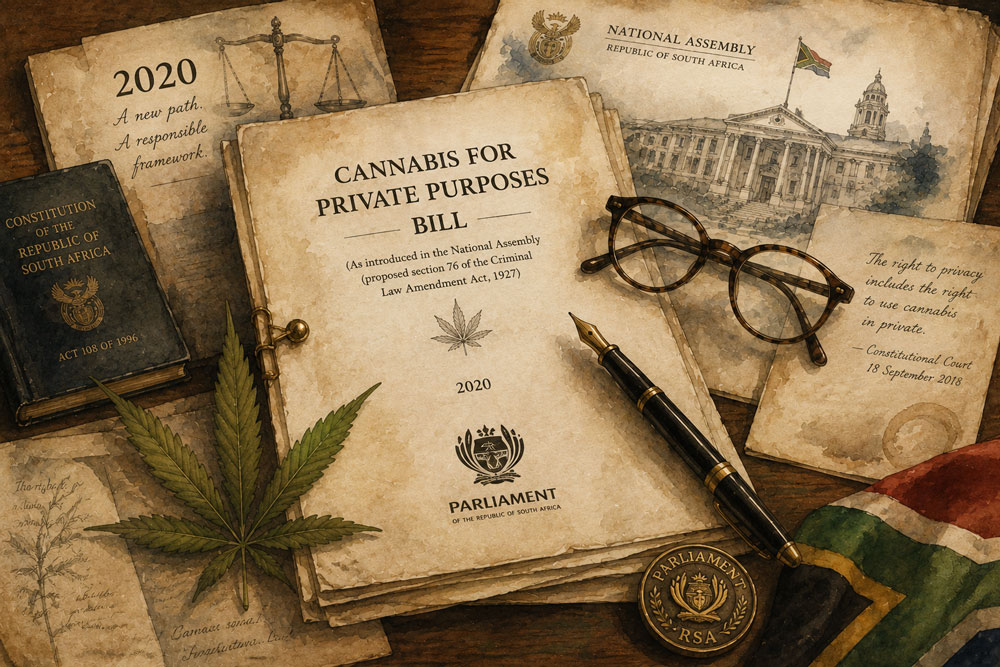
The Cannabis for Private Purposes Bill [B19–2020] landed in Parliament on 1 September 2020, just ahead of the Court's deadline.⁴
Its first draft was modest. The goal was to translate one constitutional idea (adults may possess, grow and use cannabis privately) into workable law, while keeping everything outside that private space off-limits.⁵ Parliament opened the floor to public submissions, and the questions came fast.
What, exactly, counts as private? How much cannabis is a reasonable personal amount rather than evidence of dealing? Where does home cultivation end and commerce begin? And what happens to the thousands of people already carrying criminal records for conduct the country was now choosing to protect?
None of those had tidy answers. Working through them is a large part of why a two-year deadline stretched into a six-year process.
The question nobody expected: what about children?
Somewhere in the deliberations, the Bill grew.
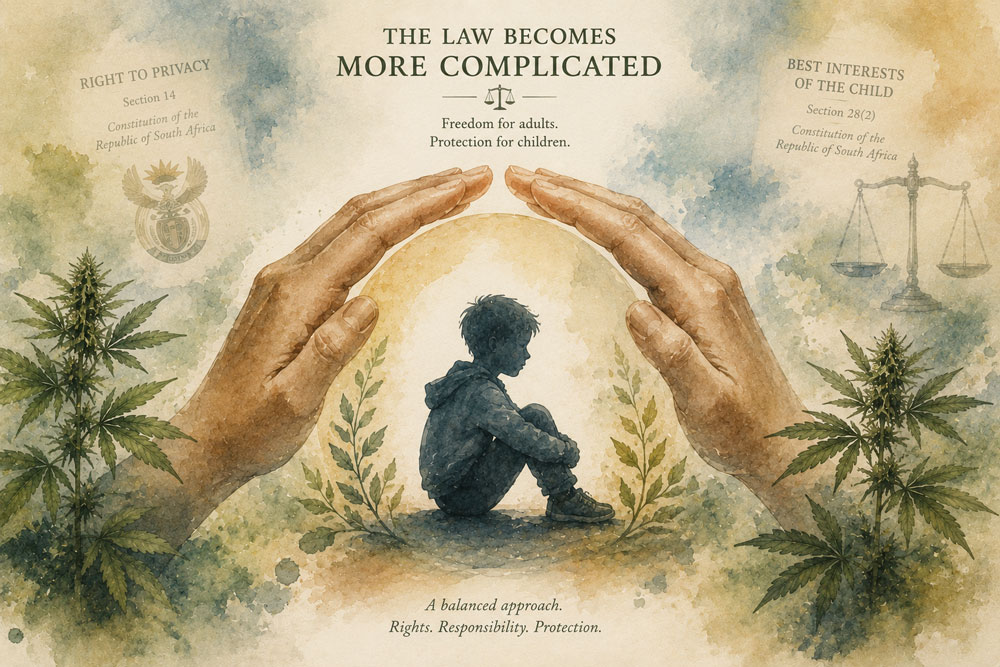
Parliament's Justice and Correctional Services Committee asked for permission to widen the Bill's scope to cover children, a move driven by the constitutional command to treat a child's best interests as paramount.⁶ You cannot simply take an adult privacy right, apply adult criminal penalties to a fourteen-year-old, and call it justice.
The revised Bill tried to hold two things at once: it aimed to keep children away from cannabis and shield them from adult use, while also creating a gentler, non-criminalising response for minors found using or possessing it.⁷
That balancing act reveals something true about drug law generally. Privacy is only one thread. Child protection, public safety, proportionality and criminal justice all pull on the same fabric, and the moment you account for all of them, "can an adult smoke at home?" stops being a simple question.
2023–2024: Six years, four steps, one signature
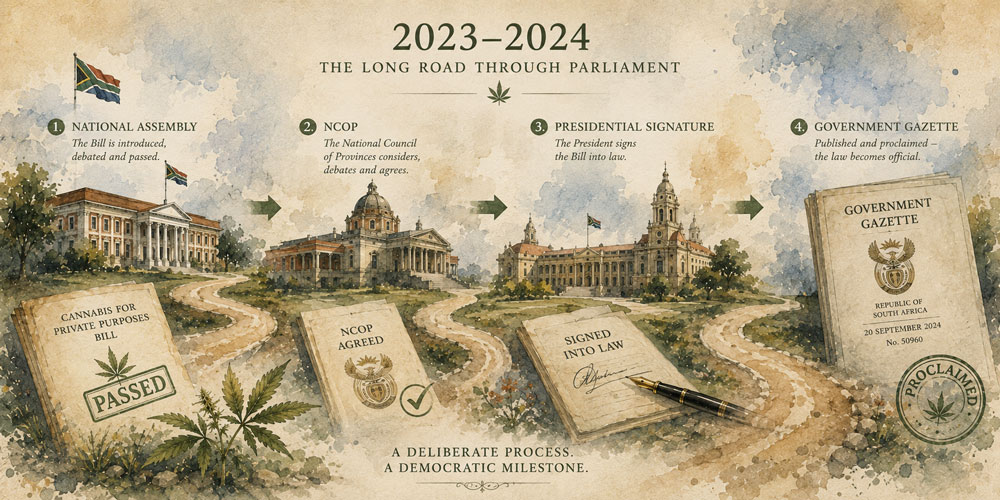
After years of hearings and redrafting, the Bill finally moved.
The National Assembly passed it on 14 November 2023.⁸ It went to the National Council of Provinces, which ran its own round of public submissions (from ordinary citizens, civil society, government departments and industry) before the Select Committee adopted it in February 2024.⁹ The NCOP passed the Bill on 27 February 2024.¹⁰
From there it went to the President. Cyril Ramaphosa signed it into law on 28 May 2024,¹¹ and the Cannabis for Private Purposes Act 7 of 2024 was published in the Government Gazette on 3 June 2024.²
Six years after Prince, South Africa had a statute built specifically around private cannabis.
What the Act actually does
The Act's own stated purpose is to protect adult privacy while regulating the private possession and use of cannabis.² In practice, it:
- recognises and regulates cannabis possession and use by adults for private purposes;
- builds in protection around children and cannabis exposure;
- keeps dealing in cannabis firmly prohibited;
- creates a route to expunge certain past cannabis convictions;
- amends related legislation; and
- allows for regulations to fill in the operational detail.²
It defines an adult, unambiguously, as anyone 18 or older.
What the Act does not do is just as important: it does not create a recreational retail market. There is no legal weed shop hiding in this statute. When the Presidency announced the signing, it made a point of saying that dealing remained an offence.¹¹ Private use and commercial trade are, and remain, two separate legal questions, a line worth remembering every time someone claims South Africa has "gone legal."
Wiping the slate: cannabis and criminal records
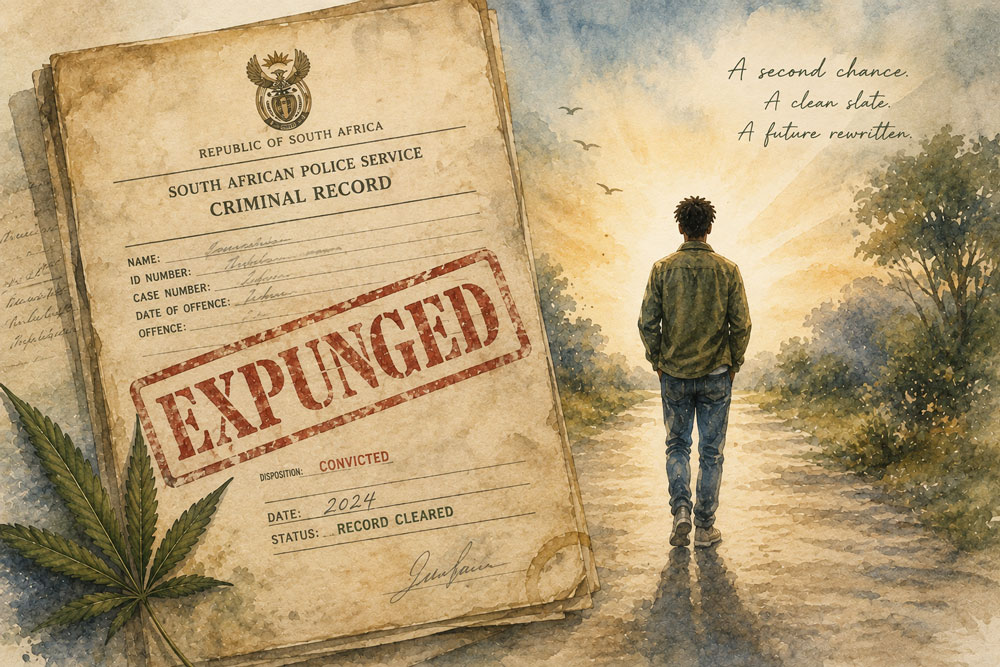
For many people, the most consequential part of the Act has nothing to do with growing or smoking. It's about the past.
For decades, South Africans were convicted for possessing or using cannabis, the very conduct that, in certain private settings, the Constitution now protects. A conviction like that doesn't stay in a courtroom. It follows people into job applications, visa forms and background checks, long after the offence itself.
The 2024 Act provides for expunging qualifying records: possession, use, and certain convictions that rested on old presumptions of dealing.² It doesn't pretend the convictions never happened. It accepts a simpler principle, when the law's judgment about a behaviour changes this profoundly, the lasting penalties attached to the old view deserve a second look. For the individuals affected, that reach (into work, travel and everyday life) is where reform stops being abstract.
The part people keep confusing: private, medical, commercial
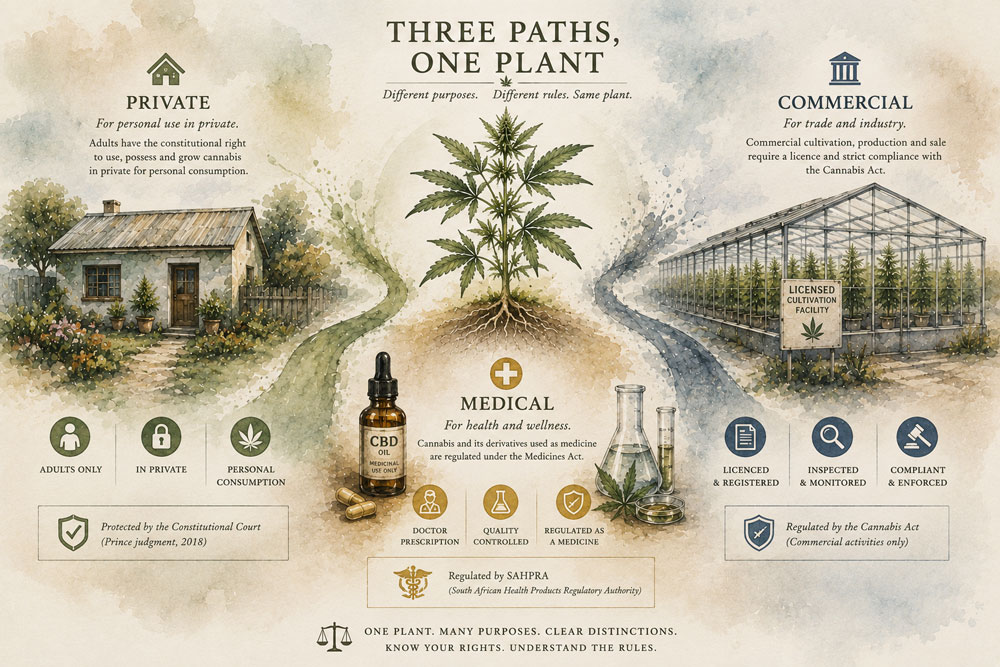
One distinction is worth repeating because it's so often collapsed.
The Cannabis for Private Purposes Act governs private cannabis. It does not replace the medicines system. Medicinal cannabis, THC-containing medicines and many CBD products still answer to the Medicines and Related Substances Act and SAHPRA's oversight.³ Growing cannabis for medical or research use remains a licensed activity, bound by rules on security, quality control and pharmaceutical standards, with SAHPRA maintaining its own cultivation guidance.¹²
So private cannabis, medicinal cannabis and commercial cannabis are not interchangeable words. Each can sit under a different Act, answerable to a different authority. Treating them as one thing is the single fastest way to get South African cannabis law wrong.
2024 wasn't the finish line – and 2026 proves it
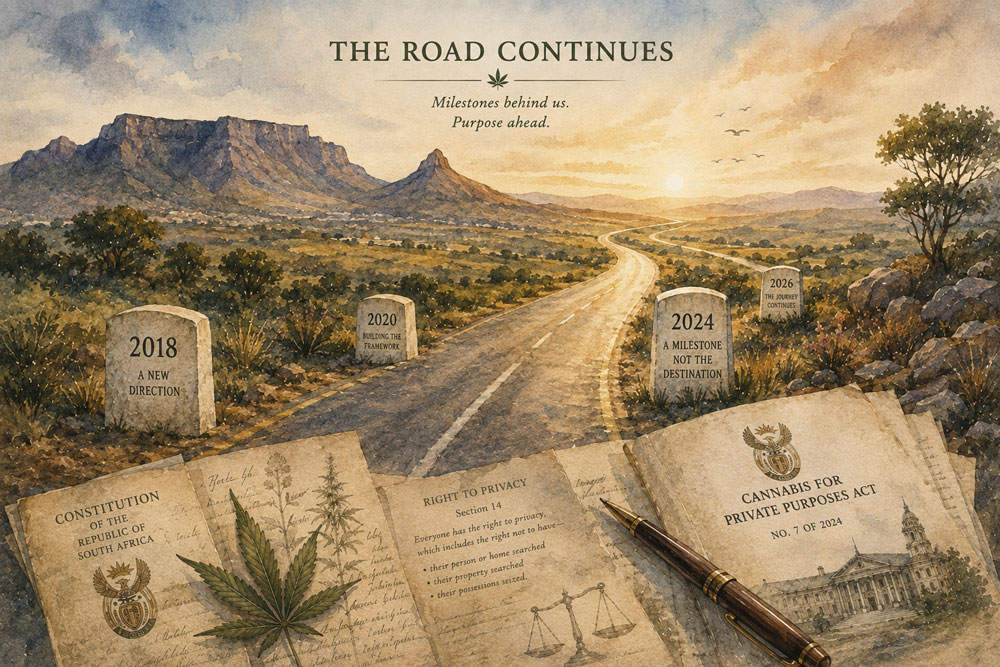
It's tempting to end a legal history on the day the President signed. Cannabis rarely cooperates.
The story so far has three clear beats: the 2018 judgment established the constitutional right; the years after it forced that right into legislative language; and the 2024 Act supplied the statutory framework. But a statute on paper is not the same as a law in force.
The Act commences only on a date the President fixes by proclamation in the Gazette, and different sections can switch on at different times.² And much of the practical detail, including the actual limits on how much an adult may possess or grow, was always going to live in regulations rather than the Act itself.
That work is still underway. As of 2026, the Act is not yet fully in operation, and on 3 February 2026 the Department of Justice and Constitutional Development published its first set of draft regulations for public comment, proposing the upper limits for private possession and cultivation and inviting the public to weigh in.¹³ In other words, the questions Parliament wrestled with in 2020 are, in a more technical form, still being answered.
Between 2018 and 2024, South Africa travelled from a court ruling protecting private conduct to an Act of Parliament designed around it. That is a genuine transformation, from prohibition, to constitutional protection, to regulation. But it was a stage in a longer journey, not its destination.
The next question is the hardest one yet: how does a country turn a constitutional principle into a cannabis framework that actually works in practice?
That's where our history continues.
References
- Minister of Justice and Constitutional Development and Others v Prince and Others (CCT108/17) [2018] ZACC 30; 2018 (6) SA 393 (CC).
- Republic of South Africa. Cannabis for Private Purposes Act 7 of 2024. Government Gazette No. 50744, 3 June 2024.
- South African Health Products Regulatory Authority. Communication to Industry: Scheduling Status of THC and CBD. Pretoria: SAHPRA; 2020.
- Parliament of the Republic of South Africa. Cannabis for Private Purposes Bill [B19–2020]. Cape Town: Parliament; 2020.
- Parliament of the Republic of South Africa. Have Your Say: Cannabis for Private Purposes Bill [B19–2020]. 2020.
- Parliament of the Republic of South Africa. Cannabis for Private Purposes Bill: Extension of Subject Matter. Cape Town: Parliament; 2023.
- Portfolio Committee on Justice and Correctional Services. Report on the Cannabis for Private Purposes Bill [B19–2020]. Parliament of South Africa; 1 November 2023.
- Parliament of the Republic of South Africa. National Assembly Passes Four Bills During Plenary Sitting. 14 November 2023.
- Select Committee on Security and Justice. Report on the Cannabis for Private Purposes Bill [B19B–2020]. Parliament of South Africa; February 2024.
- Parliament of the Republic of South Africa. NCOP Passes Three Bills and Considers Various Committee Reports. 27 February 2024.
- The Presidency, Republic of South Africa. President Cyril Ramaphosa Assents to the Cannabis for Private Purposes Bill. 28 May 2024.
- South African Health Products Regulatory Authority. Guideline for Cultivation of Cannabis. Version 3. Pretoria: SAHPRA; 2022.
- Ministry of Justice and Constitutional Development, Republic of South Africa. Ministry Invites Public Comment on Draft Regulations for the Private Use of Cannabis. 3 February 2026.
Disclaimer: This blog supports responsible cannabis use. The information contained in this article is for educational and informational purposes only and is not intended as health or medical advice. Always consult a physician or other qualified health provider regarding any questions you may have about a medical condition or health objectives.