The Complete History of Cannabis – A Global Timeline: Part 4
Part of the Cannabis Education Series. This article explores the period in which cannabis shifted from a diminishing medical presence into a formally prohibited substance within global and South African legal systems.
Read more:
- The Complete History of Cannabis – A Global Timeline: Part 1
- The Complete History of Cannabis – A Global Timeline: Part 2
- The Complete History of Cannabis – A Global Timeline: Part 3
1930 – 1970
Prohibition, Policy & the Formation of Global Control
By the early 20th century, cannabis had already begun to lose prominence within formal Western medicine. What followed between 1930 and 1970 was not a single defining moment, but a gradual consolidation of legal frameworks that would reshape the plant’s status across much of the world¹².
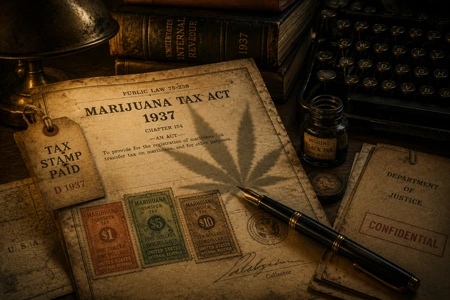
One of the most frequently referenced developments during this period was the United States’ Marijuana Tax Act of 1937. While not an outright ban, the Act introduced strict regulatory controls that made the production and distribution of cannabis increasingly difficult². Its influence extended beyond American borders, contributing to broader international attitudes toward cannabis as a substance requiring control rather than integration.
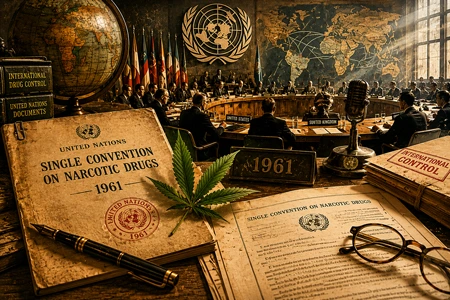
At the same time, global conversations around drug regulation were becoming more coordinated. This culminated in the United Nations Single Convention on Narcotic Drugs in 1961, which aimed to standardise international drug control policies¹. Cannabis was included within this framework, placing it under tighter global oversight and reinforcing its classification as a controlled substance.
These international developments did not occur in isolation. Many countries, including South Africa, aligned their national legislation with emerging global standards. In South Africa, cannabis had already been subject to increasing regulation earlier in the 20th century, and this period saw those controls become more structured and formalised³. Legal frameworks evolved within a broader context of governance that prioritised regulation, classification and social control.
Importantly, prohibition was not driven by a single factor. Medical uncertainty, evolving pharmaceutical standards, political priorities and international policy alignment all played a role in shaping how cannabis was perceived and regulated². Substances that did not fit easily within emerging models of standardised medicine were increasingly managed through legal systems rather than clinical ones.
During this period, cannabis use did not disappear. In many regions, including South Africa, it continued within informal, cultural and community contexts³. However, its legal status had fundamentally changed. What had once been a plant used across traditional and medical systems was now positioned within a framework of restriction.
The language surrounding cannabis also shifted. It became associated more closely with regulation, enforcement and compliance, rather than with its earlier roles in medicine and culture. This change in perception would influence public understanding for decades to come.
By the late 1960s and into the 1970s, cannabis was firmly established within global prohibition systems. Its classification under international law, combined with national enforcement frameworks, created a consistent regulatory environment across many countries.
This period represents the formalisation of cannabis prohibition.
It did not erase the plant’s history, but it redefined its legal and social position in a way that would shape future policy, research and public perception.
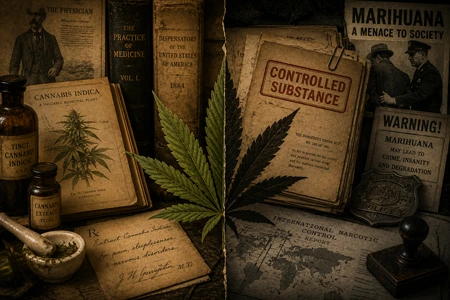
In the decades that followed, however, scientific interest in cannabis would begin to re-emerge. Setting the stage for a new phase in its history, one grounded in biological discovery rather than solely in regulation.
References
- Abel, E.L. (1980). Marihuana: The First Twelve Thousand Years.
- Booth, M. (2003). Cannabis: A History.
- Du Toit, B.M. (1975). Cannabis use in South Africa. Journal of Psychedelic Drugs.
- Li, H.-L. (1974). An archaeological and historical account of cannabis in China. Economic Botany.
- Russo, E.B. (2007). History of cannabis and its preparations in saga, science, and sobriquet. Chemistry & Biodiversity.
Disclaimer: This blog supports responsible cannabis use. The information contained in this article is for educational and informational purposes only and is not intended as health or medical advice. Always consult a physician or other qualified health provider regarding any questions you may have about a medical condition or health objectives.