Introduction
Cannabis did not begin in a courtroom.
Long before prohibition laws, political debates or regulatory frameworks, cannabis was cultivated as fibre, used as medicine and woven into cultural and spiritual practices across continents. Archaeological evidence suggests humans have interacted with the cannabis plant for at least 10,000–12,000 years¹.
In ancient China, cannabis appeared in early medical texts. In India, it formed part of the Ayurvedic tradition. Across the Middle East and Africa, it travelled through trade routes alongside spices, textiles and healing knowledge².
In Southern Africa, cannabis, commonly known as dagga, became embedded in indigenous communities long before colonial legislation attempted to regulate or criminalise it³. The plant was not originally a symbol of controversy. It was a plant integrated into social, medicinal and agricultural life.
Read more: African History of Cannabis.
Understanding this history does not romanticise cannabis. It contextualises it.
Modern cannabis law in South Africa cannot be fully understood without recognising the plant’s long-standing global presence and the political shifts that reshaped its legal status in the 20th century.
This timeline traces cannabis from ancient civilisations through prohibition, scientific rediscovery and constitutional reform. Concluding with South Africa’s evolving regulatory framework today.
Part of the Cannabis Education Series
At Cannabis Oil Research, we believe understanding cannabis requires context. This article forms part of our structured education series tracing the plant’s journey from ancient medicine to modern regulation in South Africa.
Each instalment builds on historical evidence, scientific discovery and evolving legal frameworks, with a focus on clarity, safety and responsible engagement.
10,000 BCE – 1000 CE
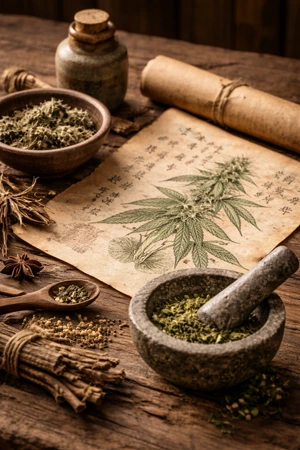
Ancient Civilisations & Early Medicine
Archaeological discoveries suggest hemp fibres were used in ancient Taiwan and China as early as 8,000–10,000 BCE, primarily for rope and textile production¹. Over time, cannabis evolved from a practical agricultural crop into a recognised medicinal plant.
One of the earliest recorded references appears in the legendary Chinese pharmacopoeia attributed to Emperor Shennong (circa 2700 BCE), which describes cannabis as a treatment for pain, inflammation and various disorders⁴. While early records blend myth and medicine, later Chinese medical texts confirm its continued therapeutic use.
In India, cannabis became integrated into Ayurvedic practice, where preparations such as bhang were used in ritual and medicinal contexts⁵. Rather than being treated as an illicit substance, it was incorporated into structured systems of health and spirituality.
Through expanding trade networks, cannabis moved westward into the Middle East and Africa. By the early centuries CE, evidence suggests the plant had spread through transcontinental exchange routes linking Asia, the Arabian Peninsula and East Africa².
In Southern Africa, historical and anthropological accounts indicate cannabis was present among indigenous communities prior to formal European colonisation³. The term dagga itself is believed to have linguistic roots in Khoikhoi or related languages, reflecting its early regional integration.
At this stage in history, cannabis was neither criminal nor politically controversial. It was cultivated, traded and used within cultural norms that shaped its meaning locally.
Control, as a formal legal construct, would come much later.
References
Abel, E.L. (1980). Marihuana: The First Twelve Thousand Years.
Booth, M. (2003). Cannabis: A History.
Du Toit, B.M. (1975). Cannabis use in South Africa. Journal of Psychedelic Drugs.
Li, H.-L. (1974). An archaeological and historical account of cannabis in China. Economic Botany.
Russo, E.B. (2007). History of cannabis and its preparations in saga, science, and sobriquet. Chemistry & Biodiversity.
Disclaimer: This blog supports responsible cannabis use. The information contained in this article is for educational and informational purposes only and is not intended as health or medical advice. Always consult a physician or other qualified health provider regarding any questions you may have about a medical condition or health objectives.