How Your Needs Change Across Phases

Women’s hormones are not static. Across a typical 28-day cycle, oestrogen and progesterone rise and fall in a predictable rhythm, and these fluctuations influence mood, pain sensitivity, sleep, appetite and stress response¹.
Cycle syncing means aligning lifestyle choices with these hormonal shifts. But where does cannabis fit in?
Read more: Cannabis and Homeostasis.
To answer that, we need to understand how the endocannabinoid system (ECS) interacts with reproductive hormones.
The Endocannabinoid System & Oestrogen
The ECS helps regulate mood, pain perception, inflammation, stress and reproductive function². Oestrogen appears to modulate ECS activity, particularly CB1 receptor sensitivity³.
Research suggests that rising oestrogen may increase sensitivity to THC³. This means the same dose can feel stronger at certain phases of the cycle.
Progesterone, on the other hand, may have a dampening effect on THC sensitivity⁴.
This matters for practical use.
Read more: The Endocannabinoid System.
Phase-by-Phase Considerations
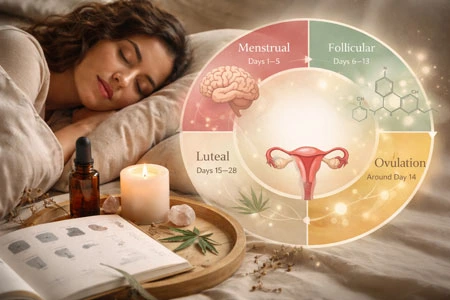
1. Menstrual Phase (Days 1–5)
Hormones are low. Prostaglandins increase, often causing cramps and inflammation.
Pain sensitivity may be higher during this phase⁵. Some individuals report benefit from CBD-dominant products for inflammatory discomfort, as cannabidiol has demonstrated anti-inflammatory and analgesic properties in preclinical and clinical research².
Low-dose THC may support pain perception and sleep, but sensitivity varies.
2. Follicular Phase (Days 6–13)
Oestrogen rises steadily. Energy and focus often improve.
Because THC sensitivity may increase alongside oestrogen³, smaller amounts may feel more noticeable. This phase may favour low-dose, clarity-focused formats if used.
CBD may support stress modulation without cognitive impairment².
3. Ovulation (Around Day 14)
Oestrogen peaks.
Higher oestrogen has been associated with enhanced cannabinoid sensitivity³. Some individuals find THC effects amplified during this window. Dose awareness becomes particularly important.
4. Luteal Phase (Days 15–28)
Progesterone rises, then drops before menstruation.
As progesterone declines, PMS symptoms may emerge: irritability, sleep disruption, fluid retention and heightened stress response⁵. Emerging evidence suggests the ECS may play a role in premenstrual symptom expression⁴.
CBD may support anxiety and sleep regulation via serotonergic and stress-modulating pathways². Lower, consistent dosing may feel steadier than large intermittent doses.
Practical & Ethical Considerations
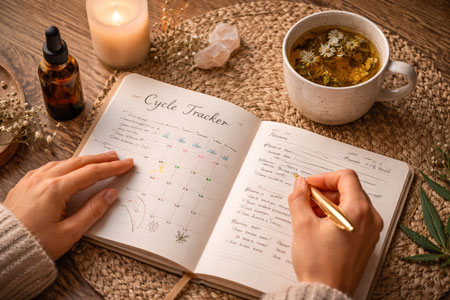
Cycle syncing with cannabis is not about increasing consumption. It is about:
Observing sensitivity changes
Adjusting dose, not escalating it
Prioritising CBD-dominant formats where appropriate
Tracking mood, sleep and symptom patterns
Importantly, high-THC exposure may disrupt ovulatory function in some contexts⁴. Cannabis should not replace medical care for severe dysmenorrhoea, endometriosis or PMDD.
The goal is informed self-awareness, not trend adoption.
When women understand their hormonal rhythm, cannabis becomes a tool that can be adjusted with the body rather than used against it.
And that is where conscious wellness begins.
Explore Further Women's Health ResourcesUnderstanding your hormonal cycle is an important step in building a more responsive wellness routine. If you would like to explore practical guidance and educational resources on cannabis and women’s health, visit the Women’s Health section in our online store, where we share carefully curated information and supportive wellness tools.
References
Reed BG, Carr BR. The Normal Menstrual Cycle and the Control of Ovulation. Endotext. 2018.
Ibeas Bih C et al. Molecular Targets of Cannabidiol in Neurological Disorders. Neurotherapeutics. 2015.
Craft RM et al. Sex differences in cannabinoid pharmacology. Pharmacology, Biochemistry and Behaviour. 2013.
Brent's LK. Marijuana, the Endocannabinoid System and the Female Reproductive System. Yale Journal of Biology and Medicine. 2016.
Bartley EJ, Fillingim RB. Sex differences in pain. British Journal of Anaesthesia. 2013.
Disclaimer: This blog supports responsible cannabis use. The information contained in this article is for educational and informational purposes only and is not intended as health or medical advice. Always consult a physician or other qualified health provider regarding any questions you may have about a medical condition or health objectives.