CBD, adaptogens and functional mushrooms increasingly appear together in products promising calmer moods, better sleep, sharper focus and greater resilience. The combination is sometimes described as a wellness stack, and it is frequently marketed specifically to women.
But seeing three ingredients packaged together does not mean science has studied them together.
There are really two questions worth asking. First, what does the evidence say about CBD, individual adaptogenic botanicals and individual mushroom species when studied separately? Second, is there evidence that combining them produces additional or complementary benefits?
The research is considerably better equipped to answer the first question than the second.
Understanding that distinction matters because evidence for individual ingredients cannot automatically be transferred to a combination containing them.
Quick answer
CBD, individual adaptogens such as ashwagandha, and mushroom species such as lion’s mane have each been studied separately, but the quality and strength of evidence differ considerably. There is currently insufficient direct clinical evidence to show that combining CBD, an adaptogen and a functional mushroom produces additional or synergistic benefits.
Why is the combination marketed to women?
There are understandable reasons why these products are positioned around women’s wellness.
Sleep disturbance, stress, fatigue and changes in mood can occur across different stages of adult life, including periods of hormonal change. This creates a natural consumer audience for products associated with calm, sleep and energy.
That context, however, is not the same as clinical evidence.
Very few trials involving these ingredients have been designed specifically around female physiology, and there is currently no established clinical evidence demonstrating that the complete CBD–adaptogen–mushroom combination is uniquely beneficial for women.
The female framing should therefore be understood primarily as a marketing and consumer context, rather than evidence for a scientifically established women-specific protocol.
CBD: clinical signals, but important limitations
Cannabidiol (CBD) is a non-intoxicating cannabinoid found in the cannabis plant.
Its pharmacology is complex and continues to be investigated. Unlike THC, CBD does not act primarily through strong direct binding to the classical cannabinoid receptors. Researchers have instead identified several possible molecular targets and signalling pathways that may contribute to its observed effects.
One frequently cited study is a 2019 retrospective case series involving patients receiving CBD for anxiety or sleep concerns. Anxiety scores decreased during the first month in approximately 79% of patients and remained lower during the study period, while sleep scores initially improved in roughly two-thirds of patients but fluctuated over time.¹
Those findings are interesting, but the study design matters.
A retrospective case series provides substantially weaker evidence than a randomised, placebo-controlled clinical trial. Without randomisation, blinding or a control group, researchers cannot confidently determine how much of an observed improvement resulted from CBD rather than placebo effects, natural changes in symptoms, other treatments or additional factors.
A later open-label Phase 2 study investigating a full-spectrum, high-CBD product also reported reductions in anxiety symptoms and found the product generally well tolerated during the study.² An open-label trial, however, also lacks the methodological safeguards of a blinded placebo-controlled study.
More recent systematic-review evidence reinforces the need for caution. Human trials investigating CBD for anxiety differ substantially in population, formulation, dose and study design.³
Taken together, there are clinical signals suggesting potential effects of CBD on anxiety, although the human evidence remains limited and heterogeneous.
Evidence concerning sleep is even less certain. Improvements reported in some studies may partly reflect changes in anxiety or other factors rather than CBD functioning as a direct sleep-inducing substance.
CBD Format and Quality Matter Too
Consumers exploring CBD products may come across oils, capsules, gummies and other formats containing very different formulations and amounts of cannabinoids. The format alone does not determine whether one product is “better” than another. Instead, it can help to look at the information available about the product and consider how well it matches your individual needs and preferences.
Useful questions may include:
How much CBD is listed per serving or recommended portion?
Does the product contain THC, and if so, how much?
What other cannabinoids, botanical ingredients or carrier oils are included?
Is the format practical for the way you intend to use CBD?
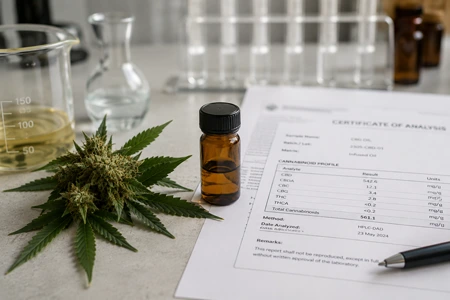
It is worth remembering that the amount of information available can differ considerably between products and suppliers. Independent laboratory testing and certificates of analysis can provide useful additional information when available, but their availability should not automatically be treated as the sole measure of a product’s quality.
A label that simply says “CBD oil” may therefore tell only part of the story. Concentration, formulation, serving size, additional ingredients and the type of CBD extract used can all help consumers make more informed comparisons.
Product information can help consumers understand what they are choosing, but product quality should not be confused with evidence that a particular CBD product will produce a specific health outcome.
Readers who would like to compare different CBD formats can explore the available product categories on Cannamart and consider which format best suits their preferences and intended use.CBD safety and medication interactions
CBD being widely available does not mean it is free from pharmacological effects.
For UK consumers, the Food Standards Agency currently advises healthy adults to limit CBD to 10 mg per day. The FSA also advises that people in vulnerable groups (including those taking medication and people who are pregnant, breastfeeding or trying to conceive) should avoid CBD unless appropriately advised.⁴
Medication interactions deserve particular attention.
CBD can influence cytochrome P450 enzymes involved in metabolising various medicines, although the clinical significance depends on factors including CBD exposure, the medicine involved and the individual.⁵
Anyone taking prescription medication should therefore discuss CBD use with an appropriately qualified healthcare professional.
Adaptogens: one label, different substances
“Adaptogen” is an umbrella term applied to certain botanicals associated with responses to physical or psychological stress.
It is useful as a historical and commercial category, but it should not imply that every adaptogenic plant contains the same compounds, works through the same mechanisms or has the same clinical evidence.

Ashwagandha
Ashwagandha (Withania somnifera) has one of the more developed human evidence bases among commonly marketed adaptogens.
A systematic review and meta-analysis of randomised controlled trials reported potential benefits across certain measures of stress and anxiety, although study populations, formulations, doses and methodological quality varied.⁶
An eight-week randomised placebo-controlled study also reported reductions in perceived stress and cortisol alongside improvements in sleep measures.⁷
Some female-specific research exists. One randomised placebo-controlled study investigating ashwagandha root extract in healthy women reported improvements across several measures of sexual function.⁸
That finding should not be extrapolated into a general claim that ashwagandha is uniquely beneficial for women.
Results are also not uniformly positive. A separate 12-week randomised trial involving adults experiencing high stress and fatigue reported benefits for some outcomes, including fatigue, without demonstrating a significant advantage over placebo for every stress measure.⁹
The evidence therefore suggests potential benefits for certain stress-related outcomes, but results depend on the population, formulation, dose and outcome being studied.
Rhodiola
Rhodiola rosea should be considered separately.
Research has explored rhodiola for fatigue, stress-related symptoms and mental performance. Some trials and reviews report potentially beneficial effects, particularly around fatigue and functioning under demanding conditions.¹⁰
The wider clinical evidence, however, is mixed. Reviews have identified contradictory findings, methodological weaknesses and substantial variation between preparations and studies.¹¹
This is an important limitation of the wider “adaptogen” category.
Evidence for ashwagandha does not automatically become evidence for rhodiola, just as evidence for rhodiola cannot be transferred to every botanical marketed as an adaptogen.
Nor do these studies demonstrate that adaptogens permanently “train” the stress response or that combining them with CBD or mushrooms amplifies their effects.
Functional mushrooms are not one clinical category
The phrase “functional mushrooms” creates a similar problem. Lion’s Mane, Reishi and Cordyceps are biologically different organisms containing different compounds and studied for different potential effects. Grouping them together can make the evidence appear more coherent than it actually is. It is more useful to consider them individually.

Lion’s Mane
Lion’s mane (Hericium erinaceus) contains compounds including hericenones and erinacines that have attracted research interest because of findings relating to nerve growth factor and other neurological pathways in laboratory and preclinical research.
Human evidence remains preliminary.
Small clinical studies have investigated cognition, mood and related outcomes, but trials have generally been limited by relatively small participant numbers, short durations or inconsistent findings.
The Alzheimer’s Drug Discovery Foundation’s assessment similarly notes that clinical trials remain small and short and that findings relating to cognition are mixed.¹²
The appropriate conclusion is therefore not that lion’s mane has been proven to improve brain function. Rather, early human research provides reasons for further investigation.
Reishi
Reishi (Ganoderma lucidum) has been investigated across a range of biological and clinical contexts, including immune-related activity.
Laboratory and preclinical research suggests that compounds within reishi can influence immune signalling, but this should not be translated into broad consumer claims that reishi simply “boosts immunity”.
Clinical evidence depends strongly on the specific outcome being investigated, and evidence for many of the stress, sleep and general wellness claims attached to reishi products remains insufficient.
Reishi may also be relevant to medication interactions. Clinical resources advise particular caution around anticoagulant or antiplatelet medicines and immunosuppressive therapies.¹³
Cordyceps
Cordyceps species and related cultivated fungal preparations have more commonly been investigated in relation to exercise physiology, fatigue and endurance.
Some research suggests possible effects on selected metabolic or endurance-related measures, but findings are inconsistent and vary according to the preparation, population and outcome studied.¹⁴
This is not the same as evidence that Cordyceps provides a generalised “energy boost”.
As with lion’s mane and reishi, the evidence should remain connected to the specific species, preparation and outcome being studied.
Calling all three ingredients “functional mushrooms” may be convenient for consumers.
Scientifically, however, they do not constitute one validated therapeutic category.
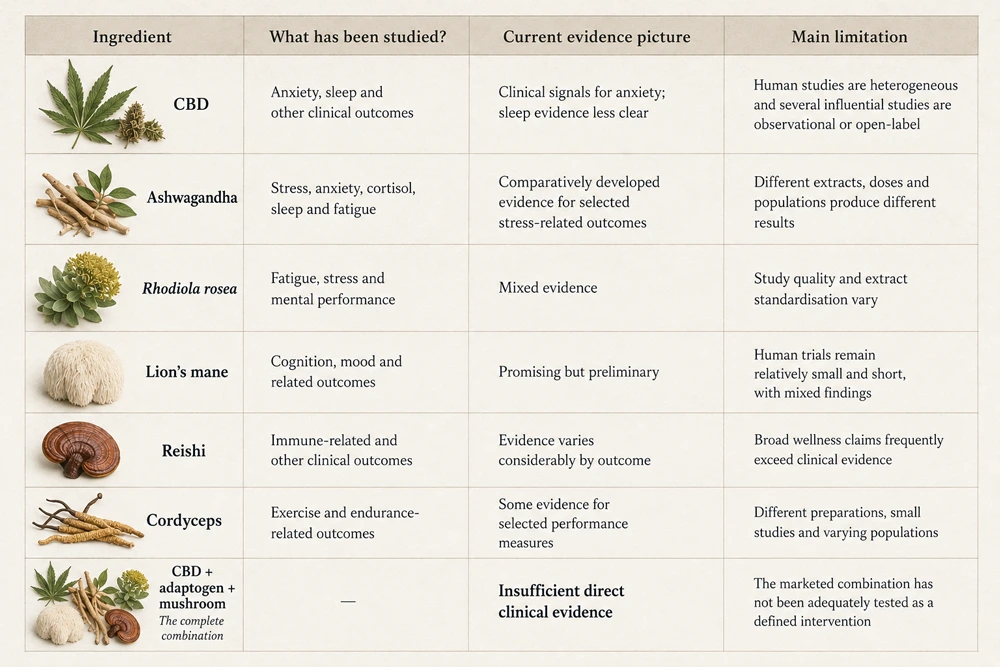
What does the evidence look like side by side?
The bigger question: what happens when you combine them?
This is where the idea of the wellness “stack” gets ahead of the research. Suppose a study finds that Ingredient A influences anxiety. Another finds that Ingredient B affects perceived stress. And a third finds preliminary evidence that Ingredient C influences a particular biological pathway.
That does not demonstrate that:
A + B + C = a better result.
Additive or synergistic benefits are separate scientific claims and require direct testing.
The clinical studies discussed above primarily investigate individual ingredients or preparations. They do not establish that CBD combined with an adaptogen and a functional mushroom produces greater or more reliable benefits than any of those substances taken independently.
Even simpler combinations illustrate how little we currently know.
A registered randomised, double-blind, placebo-controlled trial was designed to compare lion’s mane with a lion’s mane–reishi blend in young women experiencing stress or anxiety. The ClinicalTrials.gov record lists an estimated study completion date of February 2025.¹⁵
The existence of that trial should not be mistaken for published evidence supporting the broader CBD–adaptogen–mushroom combination. That distinction is central to interpreting wellness products responsibly.
Evidence for the components is not evidence for the stack.
Combining ingredients also complicates safety
The absence of combination research matters for another reason: interactions.
When several biologically active substances are taken simultaneously, predicting their combined effects becomes more difficult.
Some may potentially contribute to overlapping effects such as drowsiness. CBD can influence the metabolism of certain medicines. Reishi may be relevant to medicines affecting clotting or immune function.
The significance of these interactions depends on the ingredient, preparation, dose, medication and individual.
The evidence does not justify concluding that a CBD–adaptogen–mushroom combination is inherently dangerous.
It does justify a more measured conclusion:
Its benefits have not been established as a combination, and its combined interaction profile remains under-studied.
Quality matters across every category
Supplement labels can make very different products look remarkably similar.
Ashwagandha extracts may differ in concentration and chemical profile. Rhodiola products can contain different extracts. Mushroom supplements may vary by species, fungal material, extraction method and measured constituents.
CBD requires additional scrutiny because cannabinoid concentration and THC content are central to understanding what the product actually contains.
For CBD products in particular, consumers should look beyond front-label terms such as “premium”, “natural” or “high strength”.
A more useful sequence is:
CBD quantity per serving → THC content → batch identification → independent laboratory testing → certificate of analysis.
A certificate of analysis is most useful when it can be linked to the specific product or batch being purchased and reports meaningful laboratory findings.
Greater transparency makes it easier for consumers to understand what they are actually taking.
But it is worth repeating:
Product quality is not proof of clinical effectiveness.
Frequently asked questions

Can you take CBD and adaptogens together?
CBD and adaptogenic botanicals are available in products intended for combined use, but direct evidence showing that the combination produces additional clinical benefits remains limited. Because CBD can interact with some medicines, individual ingredients, doses and possible interactions should be considered rather than assuming a combination is automatically appropriate.
Can CBD and functional mushrooms be taken together?
Commercial products containing both categories exist, but direct clinical research examining CBD together with mushroom supplements remains very limited. Evidence for each ingredient separately does not demonstrate that taking them together produces greater benefits.
Does CBD help with anxiety?
Human research provides clinical signals suggesting CBD may influence anxiety symptoms. However, the evidence remains limited and heterogeneous, with substantial differences in study design, formulation, dose and population.
Which adaptogen has the strongest evidence?
Among adaptogens commonly marketed in wellness products, ashwagandha has a comparatively developed clinical evidence base for certain stress-related outcomes. Results are not universally positive, however, and different extracts and doses cannot automatically be treated as equivalent.
Does lion’s mane improve brain function?
Early human studies examining lion’s mane and cognition are interesting, but the clinical evidence remains preliminary. Trials have generally been relatively small and short, and findings are mixed.
Are functional mushrooms one scientific category?
No. Lion’s mane, Reishi and Cordyceps are different organisms containing different compounds and studied for different outcomes. Evidence relating to one mushroom should not automatically be applied to another.
Is the women’s wellness stack scientifically proven?
No. Individual components have different levels of research behind them, but there is currently insufficient direct clinical evidence demonstrating that a CBD–adaptogen–mushroom combination provides additional or synergistic benefits or that it is uniquely beneficial for women.
So, what does the evidence actually say?
There is no single answer because these ingredients should not be treated as one intervention. There are clinical signals for CBD in anxiety, although the evidence remains limited and heterogeneous. Ashwagandha has comparatively stronger clinical evidence for certain stress-related outcomes, although results vary between formulations, populations and studies. Rhodiola has mixed evidence relating particularly to fatigue and stress-related outcomes. Lion’s mane remains an interesting but preliminary area of human research. Reishi and Cordyceps each have their own research questions and limitations and should not inherit claims simply because they sit beneath the convenient umbrella of “functional mushrooms”.
And the evidence for the complete CBD + adaptogen + mushroom wellness stack?
That remains the weakest part of the proposition. There is currently insufficient direct clinical evidence to conclude that combining these categories creates additional, complementary or synergistic benefits. For consumers, that leads to a useful principle:
Evaluate the ingredients individually before evaluating the marketing around the combination.
A beautifully packaged stack may contain individual ingredients worth researching. It is still a stack built largely from individual-ingredient evidence rather than evidence for the combination itself. That distinction is where informed wellness decisions begin.
Readers comparing CBD formats can explore related product categories on Cannamart.
References
- Shannon S, Lewis N, Hughes S, Hughes E. Cannabidiol in Anxiety and Sleep: A Large Case Series. The Permanente Journal. 2019;23:18-041.
- Dahlgren MK, et al. Clinical and cognitive improvement following full-spectrum, high-cannabidiol treatment for anxiety: open-label data from a two-stage, phase 2 clinical trial. Communications Medicine. 2022.
- The Impact of Cannabidiol Treatment on Anxiety Disorders: A Systematic Review of Randomized Controlled Clinical Trials. 2024. PubMed PMID: 39598172.
- Food Standards Agency. Cannabidiol (CBD) guidance and consumer advice. Updated 22 June 2026. Food Standards Agency, UK.
- Evaluation of Cytochrome P450-Mediated Cannabinoid-Drug Interactions in Healthy Adult Participants. Clinical Pharmacology & Therapeutics. See also contemporary systematic-review evidence concerning CBD/THC and cytochrome P450-mediated drug interactions.
- Effects of Ashwagandha (Withania somnifera) on stress and anxiety: A systematic review and meta-analysis. Explore. 2024.
- Salve J, Pate S, Debnath K, Langade D. Adaptogenic and Anxiolytic Effects of Ashwagandha Root Extract in Healthy Adults: A Double-blind, Randomized, Placebo-controlled Clinical Study. Cureus. 2019.
- Efficacy and Safety of Ashwagandha (Withania somnifera) Root Extract for Improvement of Sexual Health in Healthy Women: A Prospective, Randomized, Placebo-Controlled Study. Cureus. 2022.
- A novel standardized ashwagandha (Witholytin) in adults with high stress and fatigue: a randomized, double-blind, placebo-controlled trial. 2023.
- Panossian A, Wikman G. Evidence-based efficacy of adaptogens in fatigue, and molecular mechanisms related to their stress-protective activity. Current Clinical Pharmacology. 2009;4(3):198–219.
- Rhodiola rosea for physical and mental fatigue: a systematic review. BMC Complementary and Alternative Medicine. 2012;12:70. See also: The Effectiveness of Rhodiola rosea L. Preparations in Alleviating Life-Stress Symptoms. Molecules. 2022.
- Alzheimer’s Drug Discovery Foundation, Cognitive Vitality. Lion’s Mane & Your Brain. Updated 2025.
- Memorial Sloan Kettering Cancer Center. Reishi Mushroom. About Herbs, Integrative Medicine Service.
- Cordyceps sinensis improves exercise performance in healthy older subjects: a double-blind, placebo-controlled trial. Journal of Alternative and Complementary Medicine. 2010;16(5):585–590.
- ClinicalTrials.gov. Effects of Hericium erinaceus and Hericium erinaceus + Ganoderma lucidum on anxiety and stress in young women. NCT06406946.
Disclaimer: This blog supports responsible cannabis use. The information contained in this article is for educational and informational purposes only and is not intended as health or medical advice. Always consult a physician or other qualified health provider regarding any questions you may have about a medical condition or health objectives.