Stress, in its simplest form, is not the problem. Your body is designed to handle stress. It relies on it. Short bursts of stress activate your nervous system, sharpen focus, and prepare you to respond. Once the moment passes, your body is meant to return to a calm, regulated state. But for many people today, that reset doesn’t fully happen. Instead, the system stays switched on.
The Biology of “Stuck”
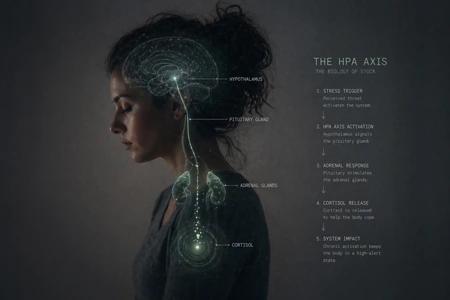
When you experience stress, your body activates the hypothalamic-pituitary-adrenal (HPA) axis. This leads to the release of cortisol, your primary stress hormone, along with adrenaline and noradrenaline¹.
In a healthy rhythm, cortisol rises when needed and falls when the stressor is gone. Chronic stress disrupts this cycle.
Over time, your body may:
- Maintain elevated or dysregulated cortisol levels
- Become less responsive to stress signals
- Struggle to shift back into a parasympathetic (rest-and-digest) state
This is where the feeling of being constantly “on edge,” wired, or unable to relax begins. Even when nothing is actively wrong, your body behaves as if something is.
Enter the Endocannabinoid System (ECS)
The endocannabinoid system is one of the body’s most important regulatory networks. Its primary role is to maintain internal balance, also known as homeostasis².
It influences:
- Mood and emotional regulation
- Sleep cycles
- Appetite and digestion
- Immune response
- Stress recovery
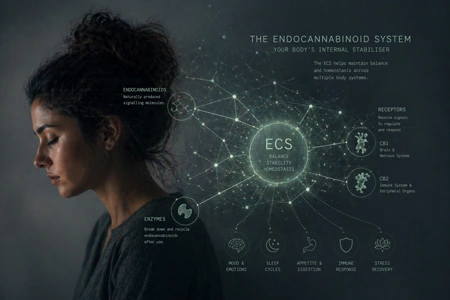
The ECS works through three key components:
- Endocannabinoids (naturally produced signalling molecules)
- Receptors (primarily CB1 in the brain and CB2 in the body)
- Enzymes that break these molecules down
In simple terms, the ECS helps your body return to baseline after disruption. It is your internal stabiliser.
When the ECS Can’t Keep Up
Chronic stress doesn’t just affect hormones, it affects the ECS itself. Research shows that prolonged stress exposure may:
- Lower levels of endocannabinoids
- Alter receptor sensitivity
- Disrupt communication between systems³
This creates a feedback loop. Stress weakens the ECS. The ECS becomes less effective. Recovery from stress slows. The body remains activated. Over time, this loop reinforces the “stuck on” state.
Why You Feel It the Way You Do
This ongoing activation doesn’t always feel dramatic. It often shows up subtly, but persistently:
- Difficulty falling or staying asleep
- Low-grade anxiety or irritability
- Mental fatigue or brain fog
- Physical tension in the body
- A sense of never fully switching off

These are not random symptoms. They are signals of a system struggling to regulate. Importantly, this is not about mindset or willpower. It is physiological.
Supporting the Reset
Restoring balance means supporting both the nervous system and the ECS. Foundational habits matter:
- Consistent sleep and light exposure
- Stable nutrition and blood sugar
- Gentle, regular movement
- Intentional down-regulation practices like breathwork

Cannabinoids such as CBD are also being studied for their role in supporting ECS function. While CBD does not directly bind to CB1 or CB2 receptors, it may influence how the system signals and responds⁴. This can help create the conditions for the body to shift out of chronic activation over time.
A Return to Regulation
The goal is not to remove stress from your life. It is to restore flexibility in your system. To activate when needed, and to come back down when it’s over. Because your body is not broken. It is simply waiting for the right signals to feel safe enough to switch off again.

References
- McEwen BS. “Protective and damaging effects of stress mediators.” New England Journal of Medicine, 1998.
- Lu HC, Mackie K. “An Introduction to the Endogenous Cannabinoid System.” Biological Psychiatry, 2016.
- Morena M et al. “Neurobiological Interactions Between Stress and the Endocannabinoid System.” Neuropsychopharmacology, 2016.
- Blessing EM et al. “Cannabidiol as a Potential Treatment for Anxiety Disorders.” Neurotherapeutics, 2015.
Disclaimer: This blog supports responsible cannabis use. The information contained in this article is for educational and informational purposes only and is not intended as health or medical advice. Always consult a physician or other qualified health provider regarding any questions you may have about a medical condition or health objectives.