Stress is not inherently harmful. In biological terms, it is a highly adaptive survival response designed to mobilise energy and sharpen focus.
Burnout, however, is something entirely different.
While often grouped, stress and burnout represent distinct physiological states and require fundamentally different approaches to recovery.
Stress: A System Working as Intended

Acute stress activates the hypothalamic-pituitary-adrenal (HPA) axis, triggering the release of cortisol alongside adrenaline and noradrenaline.
This cascade prepares the body for action:
- Increased heart rate
- Elevated blood glucose
- Heightened alertness
In short bursts, this state enhances performance. Crucially, it is designed to resolve. Once the stressor passes, the parasympathetic nervous system restores balance and returns the body to homeostasis.
Stress becomes problematic only when this recovery phase is disrupted.
Burnout: When the System Depletes

Burnout is not “too much stress.” It is the result of chronic, unresolved stress exhausting the system itself.
Research shows a phased progression:
- Early stages: increased cortisol output as the body tries to compensate
- Late-stage burnout: blunted cortisol response and HPA axis dysregulation
Instead of heightened activation, the system begins to shut down.
This explains why burnout presents differently:
- Persistent fatigue
- Emotional detachment
- Reduced cognitive function
The system is no longer overactive; it is depleted.
Read more: Supporting Workers' Wellness.
The Cortisol Curve & Nervous System Dysregulation
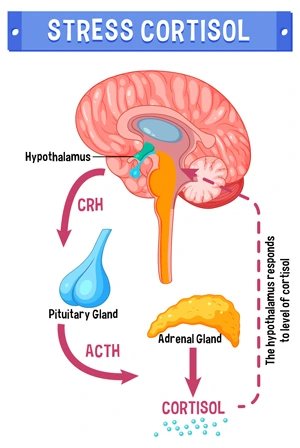
In healthy individuals, cortisol follows a diurnal rhythm, rising sharply after waking and gradually declining throughout the day.
Burnout disrupts this pattern.
A flattened cortisol curve is associated with:
- Chronic fatigue
- Insomnia
- Reduced stress resilience
Additionally, chronic stress contributes to neuroinflammation and glucocorticoid resistance, further impairing the body’s ability to regulate itself.
This reinforces the idea that burnout is not simply psychological; it is systemic dysregulation.
A Nervous System Perspective
From a polyvagal perspective, stress operates within a mobilised state (fight or flight). At the same time, burnout reflects a shift into a dorsal vagal shutdown state, characterised by withdrawal, low energy, and disconnection.
This distinction is critical.
Telling someone experiencing burnout to “push through” fails to recognise that the nervous system is no longer capable of sustained activation.
Implications for Recovery
Stress can often be resolved with rest and decompression.
Burnout requires systemic nervous system repair, including:
- Restoration of circadian rhythms
- Vagal tone support through breath and movement
- Reduction of chronic stress inputs
Emerging research also highlights the endocannabinoid system (ECS) as a key regulator of stress and homeostasis, influencing both emotional processing and recovery pathways.
Read more: High on Productivity.
Final Thought
Burnout is not a failure of resilience. It is a biological signal that the systems responsible for adaptation have been overextended. Recovery begins not with effort, but with understanding the physiology driving the experience.
If you’re experiencing ongoing stress or signs of burnout, it may help to receive personalised guidance. You can complete our free and confidential consultation form, and our team will assist you with appropriate next steps based on your needs. Request your consultation.
Disclaimer: This blog supports responsible cannabis use. The information contained in this article is for educational and informational purposes only and is not intended as health or medical advice. Always consult a physician or other qualified health provider regarding any questions you may have about a medical condition or health objectives.