Mood and focus are not purely psychological states. They are regulated by the nervous system, neurochemistry, and the body’s response to stress. Cannabinoids interact with these systems through the endocannabinoid system (ECS), which plays a key role in emotional regulation, attention, and cognitive processing¹.
Read more: The Endocannabinoid System Explained.
While CBD and THC are well known, CBG is emerging as a compound of interest for mental clarity and focus.
CBD: Supporting Emotional Regulation Without Intoxication
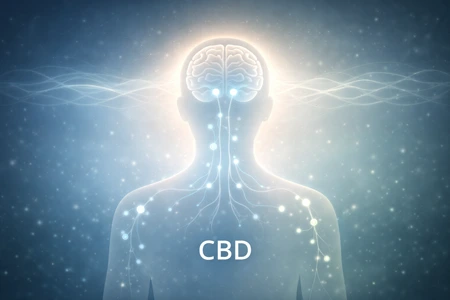
Cannabidiol (CBD) is a non-intoxicating cannabinoid that interacts indirectly with ECS receptors and influences serotonin (5-HT1A) signalling, a pathway involved in mood stability and anxiety regulation². Rather than stimulating CB1 receptors directly, CBD appears to modulate the nervous system's response to stress.
Read more: All About CBD.
Research suggests CBD may support:
Emotional balance during periods of stress
Reduced anxiety-related mental interference
Calm focus without cognitive impairment³
Because CBD does not produce psychoactive effects, it is often used by individuals seeking steadier mood and mental clarity during daily activities.
THC: Mood Elevation With Cognitive Considerations
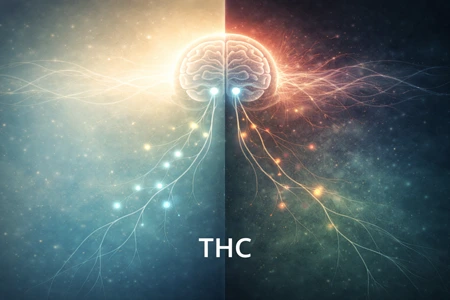
Tetrahydrocannabinol (THC) binds directly to CB1 receptors in the brain, influencing dopamine release, sensory perception, and emotional processing⁴. At low doses, THC may elevate mood and increase creativity, but its effects are dose-dependent.
Read more: CBD vs THC.
Higher or poorly timed doses have been associated with:
Reduced working memory
Slower reaction time
Increased anxiety in some individuals⁵
For those prioritising sustained focus and cognitive performance, THC requires careful dosing and context-specific use.
CBG: Emerging Evidence for Focus and Mental Clarity
Cannabigerol (CBG) is often referred to as the “parent cannabinoid” because other cannabinoids are synthesised from its acidic precursor. While human research remains limited, early findings suggest that CBG may influence attention and motivation pathways without intoxication⁶.

Read more: CBG (cannabigerol): Studies and Benefits.
Preliminary evidence indicates CBG may:
Interact with alpha-2 adrenergic receptors involved in focus
Support alertness and cognitive engagement
Influence inflammatory pathways linked to mental fatigue⁷
Unlike THC, CBG does not produce a “high,” and unlike CBD, it may feel more stimulating than calming, making it a growing area of interest for daytime formulations.
Which Cannabinoid Supports Mood and Focus Best?
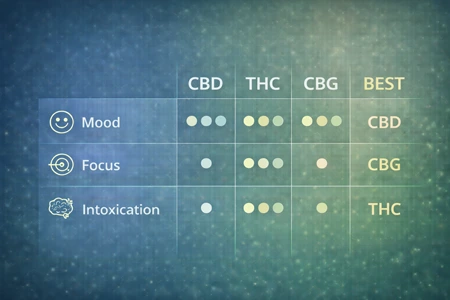
There is no universal answer. Current evidence suggests:
CBD may support emotional regulation and calm
CBG may support alertness and focus
THC may enhance mood at low doses, but carries cognitive trade-offs
Read more: Move Through the Fog.
Balanced formulations that combine cannabinoids may offer broader nervous system support, reflecting the complexity of mood and focus regulation⁸. As research evolves, informed use, conservative dosing, and individual response remain central to responsible cannabinoid wellness.
Disclaimer: This blog supports responsible cannabis use. The information contained in this article is for educational and informational purposes only and is not intended as health or medical advice. Always consult a physician or other qualified health provider regarding any questions you may have about a medical condition or health objectives.
References
- Lu, H. C., & Mackie, K. (2016). An introduction to the endogenous cannabinoid system. Biological Psychiatry.
- Russo, E. B. (2011). Taming THC: Potential cannabis synergy and phytocannabinoid-terpenoid entourage effects. British Journal of Pharmacology.
- Blessing, E. M. et al. (2015). Cannabidiol as a potential treatment for anxiety disorders. Neurotherapeutics.
- Pertwee, R. G. (2008). The diverse CB1 and CB2 receptor pharmacology of cannabinoids. British Journal of Pharmacology.
- Broyd, S. J. et al. (2016). Acute and chronic effects of cannabinoids on human cognition. Biological Psychiatry.
- Nachnani, R. et al. (2021). Cannabigerol: A review of its therapeutic potential. Cannabis and Cannabinoid Research.
- Cascio, M. G. et al. (2010). Evidence that the plant cannabinoid cannabigerol is a competitive alpha-2 adrenoceptor agonist. British Journal of Pharmacology.
- Russo, E. B. (2019). The case for the entourage effect and conventional breeding of clinical cannabis. Frontiers in Plant Science.